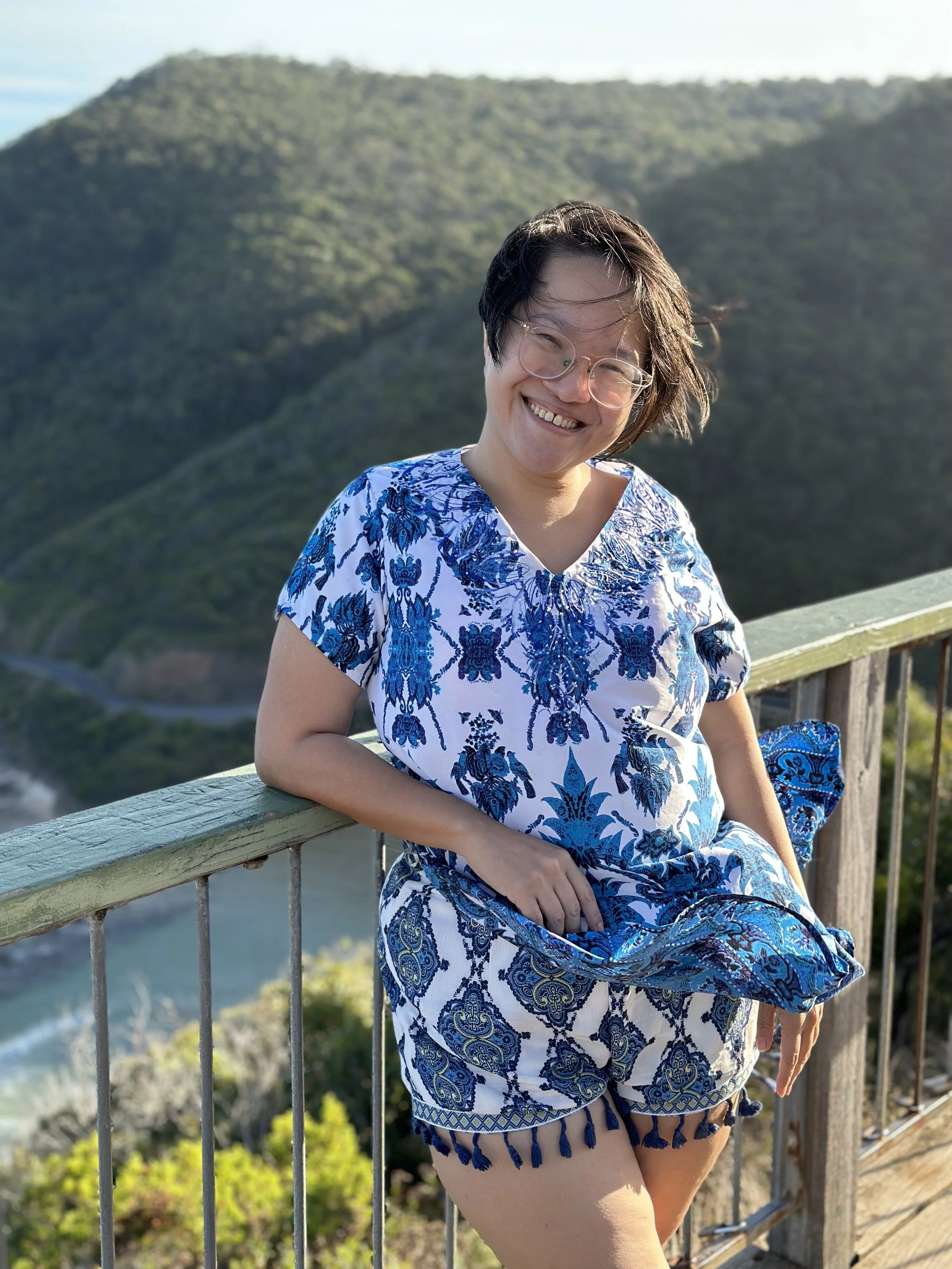
Who am I and Why I do what I do
I remember telling spooky ghost stories to my younger cousins when I was growing up. Watching them lean in, hold their breath and then jump at the scary parts gave me a small sense of power and control. For a little while, I could shape the fear in the room instead of being swallowed by my own. Being the storyteller of haunted tales took some of the weight off the adversity I was living through as a child.
I grew up with a mother who had a mental illness. She was often angry and sad. Art became my refuge, a place that offered me a safe space to express myself when it felt like there was no emotional space left in my home. Living with a mother who carried so much unspoken pain meant there was no room for my own emotions. As I grew up, I learnt to sacrifice my needs to meet hers. I know the pain, grief and anger of not being seen as who I truly was.
I became an art therapist to learn how to witness my own messy stories and my ongoing emerging and becoming. I came to understand how precious and rare it is to be genuinely seen and heard, because I had spent so long standing on the outside of that experience.
Somewhere along the way, in the journey of becoming a therapist, I put on the armour of psychological jargon, intellectual concepts and the identity of an expert. Yet I was still haunted by my mother’s mental illness, by ancestral trauma and by family stories that felt too big and too messy to be contained in neat theories.
In my doctoral research, I opened up about being haunted by my mother’s ghost and by intergenerational trauma. I created large scale paintings about this haunting that felt raw, authentic and deeply liberating. I offered critiques of the systems that haunted both me and my late mother: colonisation, patriarchy and systemic racism. These gestures felt like resistance and rebellion against the idea of the tidy, normal scholar that academic institutions wanted to shape me into.
My family stories were tangled and tied up in knots. I longed for what other children seemed to have, a sense of being normal and of belonging. I often felt too messy, too guarded, as though my trauma was too big for my body. I knew I was different, and at times that difference did not feel like a blessing. I tried to contort my body, my speech and my behaviour to fit in. On the surface, I succeeded as an impostor for normal, but inside I knew I was performing. The part of me that was whimsical and different kept spilling out in other ways, quietly insisting on being heard and seen.
Now I know I want to be a different sort of therapist, one who is authentic, brave and vulnerable. I believe that because I have met some of the scariest shadows in myself with compassionate self witnessing, and because I continue to do my own therapy and inner work, I can be of better service to my clients. I have sat with shame, anger and grief. I have alchemised much of my pain and suffering so that I can now be a steady witness to yours.
Just as a snake’s venom can be transformed into antidote, I continue to use art as medicine. I turn murky feelings into compost that can nourish new growth. I exchange the demand to be normal for an honouring of difference. I turn silence into a voice that speaks truth and strength.
Some days I am still haunted by the shadows of what has gone before me. The difference now is that these are ghosts I can befriend, sit beside and ask, “What do you need from me?” I know I can always return to the therapeutic magic of art making. Stories find their way into the light through jagged lines, torn edges and smudged paint.
This is the gift I offer to you as an art therapist. Your stories, with all their messy imperfections and raw vulnerabilities, are not something to hide. They hold treasures for insight and self discovery. They remind you of your aliveness, your capacity to feel your tears, as well as your capacity to feel more joy, awe and wonder.
From my heart to yours, Eva
The tapestry of my journey as an art therapist, an artist, a researcher has guided me toward three core values that inform how I show up, practice, and teach.
Compassion
Compassion is noticing suffering and moving gently towards it, instead of looking away. It is a soft and steady impulse to care, to ease pain, to stand beside someone in their difficulty, even in very small ways. I witness your suffering not as a personal failure, but as entanglement with collective trauma and systems. I have deep reverence for our shared humanity, even if your ancestral lineage may be diverse and different.
Intuition
Intuition is the deep listening and quiet knowing that arrives before the words do. It is a way of knowing that lies in the body, in relationship, in the unconscious, and in our cultural and ancestral memory. Tending to my intuition helps me honour my truth so I could show up authentically for you. Art is one of the quickest pathway I know to reclaim your intuition.
Creativity
Creativity is an expression of your aliveness; it is your birthright. I believe we are all inherently creative and we are always already creating from moment to moment; whether through our thoughts, speech and behaviour. Creative acts are finding tiny cracks of possibility when life felt unbearable. It is the willingness to experiment and try something different, instead of giving up entirely.